Engineering notes · Published on LinkedIn
AI seems to be becoming a scout for humans.
Yesterday I posted a document on our internal Confluence. It compared a planning document with an API specification.
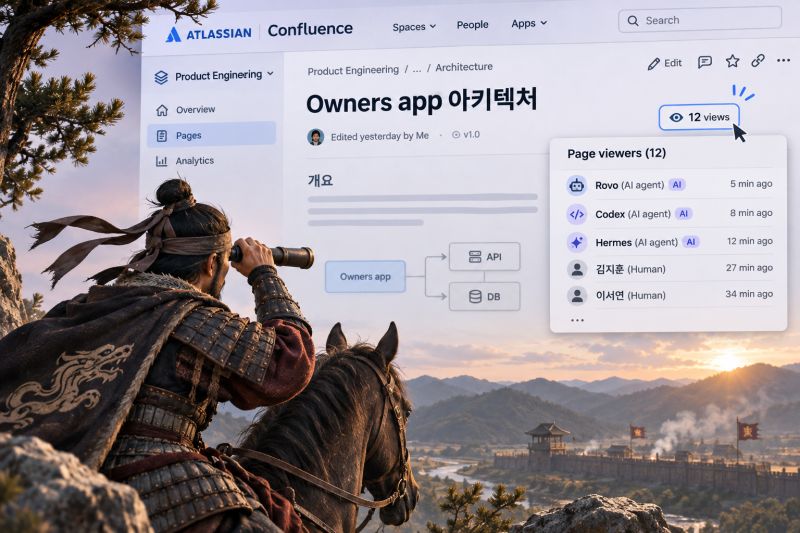
AI seems to be becoming a scout for humans.
Yesterday I posted a document on our internal Confluence. It compared a planning document with an API specification.
If you’ve used Confluence, you know you can see who read a document and when. I’d shared it with just one teammate, but the view count kept rising, so I opened the viewing history. I figured a notification from the Confluence space had brought people in.
The readers were an interesting bunch.
Rovo, Codex, Hermes…
They were AI agents people had connected to their work environments.
It made me wonder. Isn’t AI already working like a scout? It goes ahead, gathers information, makes sense of it, and reports back. The human can then go and see for themselves. Sure enough, the agents’ entries in the viewing history were followed by accounts that were 100% human.
The funny thing is, an AI agent helped me write that very document. I gave it the requirements and the direction for the analysis, let it do the initial prep and organizing, then reviewed and published the result myself.
So an AI wrote a document guided by one person’s intent. A human reviewed and published it. Another human’s AI read it first, and only then did that human read it.
AI has started taking part in how we consume information as well as how we produce it.
Until now, we’ve thought about how to write documents that people can read easily. Perhaps we should start thinking about how to make them easy for both people and AI to read and understand.
The way knowledge gets produced and circulated inside organizations may already be changing much faster than we realize.
#AI #AIAgent #Confluence #KnowledgeManagement #DigitalTransformation #FutureOfWork