Engineering notes · Published on LinkedIn
An old-school developer’s take
Something I keep telling colleagues and friends lately: “Don’t be embarrassed to develop with Claude Code.”
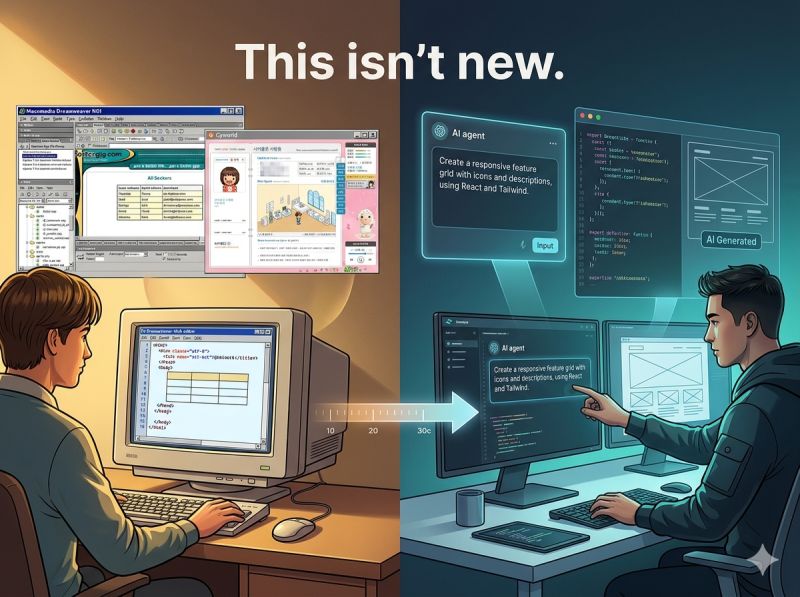
An old-school developer’s take
Something I keep telling colleagues and friends lately: “Don’t be embarrassed to develop with Claude Code.”
Claude Code is the next development tool to emerge as our environment evolves. We used to hear “In my day, we coded in vi.” I’m from the personal-homepage boom of the early 2000s. We hand-coded HTML, CSS and JavaScript. Then Namo WebEditor and Dreamweaver let us make websites almost as if we were writing a Word document. We installed or plugged in message boards and guestbooks. Sound familiar? It felt a lot like vibe coding.
Web applications and open-source projects poured out then, much as AI agents are pouring out now. Eventually people discovered the limits of assembling things others had made. Community sites and Cyworld mini-homepages came along. Anyone could set up a page, decorate it and socialize. People moved from producing to consuming. With mobile and social media, building a standalone homepage became a specialist’s job again.
I see AI following a similar path. Developer tools went from vi to text editors to IDEs to AI agents. Human behavior goes the other way. “This is easy” becomes “I can’t be bothered.” For some, even writing a good prompt already feels like a chore.
Today’s AI harnesses remind me of the old CGI hosting days. Back then it was message boards, guestbooks, polls and skins. Now it’s agents, plugins and templates. The next stage looks clearer to me: AI that people simply consume, without having to specify “this goes here, that goes there.”
One thing seems certain. Development gets more complex. Production gets faster, but how far you can refine and scale the result depends on people’s capabilities, increasingly on how they design and operate the environment.
Over the next two years, three developer skills stand out to me:
1. The planning ability to diagnose a problem.
2. The organizational ability to divide the work and design roles.
3. The technical judgment to set direction using architecture and design patterns.
I’m not saying every developer has to operate at that level. But it seems clear that developers taking the next step are moving in that direction.
All essays